Can ONDO Reach $10? Ondo Finance Price Analysis

Can ONDO reach $10 in the next crypto market cycle? It’s possible. But investors need to understand what that actually means.
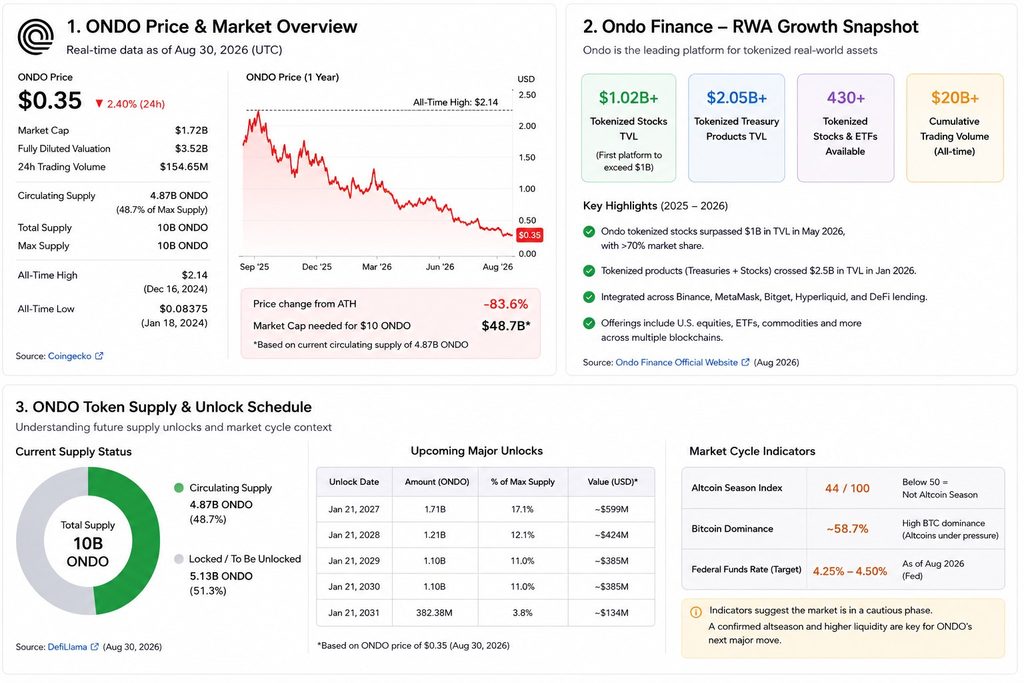
ONDO currently trades around $0.35, giving Ondo a market capitalization of roughly $1.7 billion. About 4.87 billion ONDO tokens are currently circulating, while the maximum supply is 10 billion. ONDO’s all-time high remains approximately $2.14, reached in December 2024.
So reaching $10 would require a dramatic repricing. At today’s circulating supply, $10 ONDO would imply a market cap of approximately $48.7 billion. If all 10 billion tokens were circulating, the implied fully diluted valuation would be $100 billion.
But, that’s not a small move as it would require Ondo Finance to become one of the largest crypto assets in the market. So, is that realistic? Let’s find out.
There are legitimate reasons to believe ONDO could outperform if tokenized real-world assets become one of the defining narratives of the next major crypto expansion.
But there are also serious risks including token unlocks, competition, regulation, macroeconomic tightening and the possibility that the broader altcoin market never enters the kind of euphoric phase required for a $10 valuation.
Here are the 10 biggest factors to watch.
1. Ondo Has Moved From an RWA Bet to a Broader Tokenization Platform
The biggest change since the original ONDO thesis was written is simple:
Ondo has built much more than a tokenized Treasury platform. Its earlier growth story centered heavily around products such as USDY, a yield-bearing token backed by short-duration U.S. government securities, and OUSG, its institutional tokenized Treasury product.
Although, those products remain important, but Ondo’s strategy has expanded aggressively into tokenized equities, ETFs, commodities and the infrastructure needed to bring traditional capital markets onchain.
That expansion matters because it increases Ondo’s potential addressable market.
In January 2026, Ondo said its tokenized products had surpassed $2.5 billion in total value locked, making it the largest platform for both tokenized U.S. Treasuries and tokenized stocks by its reported metrics. Its Treasury products represented roughly $2 billion in TVL, while Ondo Stocks had exceeded $500 million.
Then the growth continued and in May 2026, Ondo reported that its tokenized stocks had surpassed $1 billion in TVL, making it the first tokenized-stock platform to reach that milestone. The company reported more than 70% market share and approximately $18 billion in cumulative trading volume.
Why this matters for ONDO
If Ondo becomes infrastructure for multiple categories of tokenized assets not just Treasuries the long-term investment thesis becomes considerably larger.
But there’s an important distinction: Growth in Ondo’s products does not automatically mean equivalent value accrues to the ONDO token.
ONDO is primarily a governance token, and investors should not assume that every additional dollar of Ondo TVL directly translates into a dollar of ONDO value.
That distinction is critical when evaluating a $10 target.
2. Tokenized Stocks Could Be Ondo’s Biggest Growth Engine
Ondo Stocks launched in September 2025 and has rapidly expanded its catalog of tokenized U.S. equities and ETFs.
By May 2026, Ondo said the platform had more than $1 billion in TVL. Earlier in the year, it had already surpassed $500 million and offered more than 200 tokenized stocks and ETFs across Ethereum, Solana and BNB Chain.
Ondo has also pushed these assets into existing crypto infrastructure. For example:
- Binance made Ondo tokenized securities available through Binance Alpha.
- MetaMask integrated hundreds of Ondo tokenized U.S. stocks and ETFs.
- Bitget added Ondo tokenized equities, ETFs and commodity-linked products to its centralized exchange.
- Ondo tokenized stocks have expanded into Hyperliquid’s HyperEVM.
- Ondo stocks have also begun entering DeFi lending markets through integrations involving Morpho and Gauntlet.
This creates a potentially powerful flywheel:
more assets → more distribution → more users → more liquidity → more integrations → more tokenized financial activity.
Whether that flywheel ultimately drives ONDO toward $10 remains uncertain. But it makes the underlying Ondo business considerably more interesting than it was a year ago.
3. The RWA Market Is Still a Huge Long-Term Opportunity
The real-world asset narrative isn’t just crypto marketing as major financial institutions continue to explore tokenization because blockchain infrastructure can potentially improve settlement, distribution, transparency and market accessibility.
McKinsey estimates that tokenized financial assets could reach approximately $2 trillion by 2030 in its base case, excluding cryptocurrencies and stablecoins. Its bullish scenario reaches roughly $4 trillion.
That’s more conservative than some older industry forecasts. For example, an earlier BCG/ADDX estimate projected as much as $16 trillion of tokenized assets by 2030.
The important point isn’t which forecast wins.
It’s this: Even conservative forecasts imply that tokenization could become a multi-trillion-dollar financial market.
Ondo is already one of the largest companies building infrastructure around that trend. That gives ONDO exposure to a potentially enormous secular growth market.
However, investors should avoid a common mistake:
A large RWA market does not mean Ondo will capture the entire market.
BlackRock, JPMorgan, Franklin Templeton, Securitize, Circle, Coinbase and numerous other financial and crypto companies are also competing in tokenization. Ondo has a strong position but it does not have a monopoly.
4. Ondo’s Institutional Infrastructure Is Becoming a Real Competitive Advantage
The stronger argument today is the infrastructure Ondo has built around regulated tokenization.
In 2026, Ondo announced a U.S. tokenized-securities model involving BlackRock’s iShares Core S&P 500 ETF (IVV) and Micron shares, with the underlying securities remaining within the traditional U.S. regulated custody chain. The tokenized entitlements are issued through Ondo’s SEC-registered transfer-agent infrastructure and use Broadridge’s governance capabilities for shareholder communications and proxy voting.
Ondo has also described an integrated U.S. infrastructure stack involving:
- an SEC-registered transfer agent,
- broker-dealer capabilities,
- an investment adviser,
- and an alternative trading system.
The company says this infrastructure is designed to support multiple models of tokenized securities in the United States. This is important because tokenization isn’t simply a blockchain problem.
It’s a regulatory, custody, settlement, compliance, distribution and liquidity problem. The companies that solve those problems may ultimately capture the most value.
5. Ondo Is Expanding Distribution Across the Crypto Ecosystem
A great product doesn’t matter if nobody can access it. Ondo appears to understand that and a result of that, its tokenized assets are now being distributed through some of the biggest names in crypto.
Binance integration gives Ondo access to a massive global user base. MetaMask puts tokenized securities inside a major self-custodial wallet. Bitget adds centralized-exchange distribution. Hyperliquid opens another important trading ecosystem.
That distribution strategy may be more important than any individual partnership. Think about the difference between:
“We created 200 tokenized stocks.”
and:
“Those assets are available wherever millions of crypto users already trade and manage assets.”
The second is a much stronger business model. If tokenized securities become a standard part of crypto portfolios, Ondo’s existing distribution network could become a significant advantage.
6. Ondo Is Building Infrastructure, Not Just Products
Another major development is Ondo’s move toward its own blockchain infrastructure.
Ondo originally introduced Ondo Chain as an omnichain network designed specifically for real-world assets, with features such as permissioned validators, open participation for users and developers, institutional-grade governance and native support for RWA-focused DeFi applications.
In July 2026, Ondo introduced the Ondo Network, describing it as an evolution of its infrastructure strategy. The significance is straightforward.
If Ondo can become infrastructure used by issuers, applications, institutions and investors, not simply the issuer of a few tokenized products its potential market becomes much larger.
This is also why Ondo’s 2025 acquisition of blockchain infrastructure company Strangelove matters. The acquisition was designed to strengthen Ondo’s engineering capabilities and support its full-stack RWA infrastructure ambitions.
This is a fundamentally different thesis from “ONDO will go up because RWA is trending.” It’s a bet that Ondo can become part of the underlying infrastructure of tokenized capital markets.
7. The Current Market Does Not Yet Confirm a Full Altcoin Season
Recent Altcoin Season Index readings have remained below 50, meaning the market has not yet demonstrated the broad-based outperformance normally associated with a full altseason. One recent reading was 38, while another was reported around 44.
That doesn’t mean ONDO cannot rally. It means investors shouldn’t confuse:
“altcoins are recovering”
with:
“altseason has officially arrived.”
There is a second problem. Bitcoin has recently experienced a sharp correction. On August 29, 2026, BTC fell below $78,000 after trading above $80,000 earlier in the week, with investors reacting to a more hawkish interpretation of Fed Chair Kevin Warsh’s Jackson Hole comments.
So the current environment is better described as: selective risk-taking + high macro uncertainty, rather than an unquestionable altcoin mania.
That’s actually useful information for ONDO investors.
If Bitcoin stabilizes, liquidity improves and altcoins begin outperforming consistently, ONDO could benefit disproportionately because RWA remains one of the market’s strongest institutional narratives. But that confirmation has to come from the market.
8. The Macro Environment Is a Risk, Not a Guaranteed Tailwind
The Federal Reserve maintained the federal funds target range at 3.50%-3.75% in July 2026, while acknowledging that inflation remained elevated relative to its 2% objective.
Then came the August Jackson Hole meeting. Fed Chair Kevin Warsh emphasized the need to control inflation and indicated that further tightening could be necessary if inflation doesn’t move sufficiently toward the 2% target. Markets subsequently increased the probability assigned to a September rate hike.
That’s not the macro backdrop you want to describe as a simple “hunt for yield.” Higher-for-longer, or potentially tighter, monetary policy can reduce appetite for speculative assets.
And that matters enormously for a token like ONDO.
The better way to think about macro, There are two competing forces:
Bullish:
Tokenization is gaining institutional adoption.
Bearish:
Tighter financial conditions can compress crypto valuations.
If the RWA adoption story continues while global liquidity improves, ONDO could benefit from both fundamental growth and multiple expansion. If inflation forces central banks to remain restrictive, ONDO could struggle even while the underlying business grows.
9. ONDO’s Supply Situation Is More Complicated Than It Looks
Approximately 4.87 billion ONDO, 48.7% of the 10 billion maximum supply has been unlocked.
That means more than half of the maximum supply remains subject to future unlocking. And the next major scheduled annual unlock is expected in January 2027, with approximately 1.7 billion ONDO involved according to current vesting data.
This creates a very different setup.
The bullish interpretation
As more tokens enter circulation, the market has greater visibility into the eventual supply structure. If demand grows faster than new supply, ONDO can still appreciate substantially.
The bearish interpretation
Large unlocks can create selling pressure. That is particularly important because $10 requires ONDO to achieve an enormous market capitalization. The supply schedule therefore isn’t a reason to automatically expect a supply shock. It is something investors should monitor closely.
For ONDO, demand growth has to outrun dilution. That’s the real equation.
10. A $10 ONDO Price Is Mathematically Possible, but It Requires a Massive Revaluation
Now we get to the question that everyone actually wants answered.
Can ONDO reach $10?
Yes. But the math matters. At approximately 4.87 billion circulating tokens:
| ONDO Price | Approx. Market Cap |
|---|---|
| $0.35 | $1.7B |
| $1 | $4.9B |
| $2 | $9.7B |
| $3 | $14.6B |
| $5 | $24.3B |
| $7.50 | $36.5B |
| $10 | $48.7B |
At the full 10 billion token supply, $10 ONDO would represent a $100 billion fully diluted valuation.
That puts the target into perspective. ONDO doesn’t merely need to return to its previous all-time high. It needs to become a crypto asset worth tens of billions of dollars. That’s possible during a major crypto bull market.
But it isn’t something investors should treat as the default outcome.
A more realistic scenario framework
Rather than pretending anyone can predict an exact future price, a scenario model is more useful:
Bear case: $0.20-$0.50
The crypto market remains weak, monetary policy stays restrictive, RWA adoption grows but token-value accrual remains limited, and supply unlocks weigh on ONDO.
Base case: $1-$3
Ondo maintains a leading position in tokenized Treasuries and equities, the broader crypto market recovers, and ONDO returns toward or above its previous cycle highs.
Strong bull case: $3-$7
Tokenized assets become a dominant crypto narrative, institutional adoption accelerates, Ondo maintains leadership in tokenized equities and Treasuries, and a broad altcoin rally develops.
Extreme bull case: $7-$10+
This would require much more than RWA adoption.
It would likely require a powerful crypto-wide liquidity cycle, sustained altcoin outperformance, strong growth in Ondo’s tokenized asset ecosystem, significant institutional adoption and enough demand to absorb future ONDO supply.
In other words: $10 is a possible high-end outcome, not the most probable outcome based on today’s data.
What Could Stop ONDO From Reaching $10?
A good ONDO analysis shouldn’t only list bullish catalysts. Here are the risks that could invalidate the thesis.
1. Token value may not capture business growth
Ondo can grow its TVL and tokenized-stock volume without ONDO necessarily appreciating at the same rate.
The ONDO token’s primary role is governance, so investors need to distinguish the value of Ondo Finance the business/ecosystem from the value of ONDO the token.
2. Future token unlocks
With roughly half of the total supply still subject to vesting, future unlocks represent a meaningful source of potential selling pressure.
3. Competition
Ondo isn’t operating in an empty market. BlackRock, Franklin Templeton, JPMorgan, Securitize, Coinbase and other financial and crypto companies are building tokenization infrastructure.
The RWA market can grow dramatically while individual market shares change.
4. Regulatory risk
Tokenized securities operate at the intersection of securities law, custody, transfer restrictions, investor eligibility and blockchain infrastructure.
Ondo’s regulatory infrastructure is an advantage. It is not a guarantee that regulation will always move in its favor.
5. Macro risk
Higher interest rates and tighter liquidity can hurt speculative crypto assets even when their underlying fundamentals improve. The August 2026 Fed shift is a good reminder that macro conditions can change quickly.
6. Altcoin-season risk
A rising Bitcoin does not automatically mean an altcoin boom. ONDO needs capital to rotate into higher-beta assets for the $10 scenario to become realistic. Recent altcoin indicators still don’t provide definitive confirmation of that environment.
So, Can ONDO Really Reach $10?
Yes, but the argument needs to be much more nuanced than it was a few months ago.
The bullish thesis is stronger in some ways. Ondo has:
- surpassed $1 billion in tokenized-stock TVL;
- established a major position in tokenized U.S. Treasuries;
- expanded tokenized stocks across major chains;
- integrated with Binance, MetaMask and Bitget;
- brought tokenized securities into DeFi lending;
- expanded toward Hyperliquid;
- developed regulated U.S. tokenization infrastructure;
- expanded its institutional partnerships;
- and continued building dedicated RWA infrastructure.
Those are real developments. But the $10 thesis has also become more demanding.
At today’s circulating supply, ONDO needs a market cap approaching $49 billion to reach $10.
At full supply, the implied valuation reaches $100 billion. And the current market isn’t giving investors a clean “altseason is here” signal yet.
That’s why I would frame the opportunity this way:
ONDO has a credible path to becoming one of the major RWA assets of the current crypto cycle. A $10 price is possible in an extreme bull case, but it requires both massive Ondo ecosystem growth and a broad crypto liquidity cycle.
That is a much stronger investment thesis than simply saying “ONDO is an RWA leader, therefore it will hit $10.”
ONDO Price Targets to Watch
Instead of focusing exclusively on $10, investors can monitor several milestones.
$1: First major psychological recovery
A move back to $1 would put ONDO around a $4.9 billion market cap at today’s circulating supply. That would represent a meaningful recovery but would still leave ONDO below its previous all-time high.
$2.14: Previous all-time high
ONDO’s December 2024 ATH remains approximately $2.14. A clean breakout above this level would provide much stronger evidence that the market has entered a new price-discovery phase.
$3-$5: Major bull-market territory
At these prices, ONDO’s market capitalization would be approximately $14.6-$24.3 billion using today’s circulating supply. That would already make ONDO a significant large-cap crypto asset.
$7.50-$10: Extreme bull case
At $10, ONDO approaches a $49 billion market cap before accounting for additional tokens entering circulation. This is where the valuation argument becomes substantially harder.
To justify it, investors would need to see evidence that Ondo isn’t merely participating in tokenization—but becoming one of the dominant infrastructure providers for it.
Final Verdict: Is $10 ONDO Realistic?
Possible? Yes. Probable from today’s data? Not yet.
The most compelling part of the ONDO thesis isn’t a technical chart pattern or a prediction that “altseason is coming.”
It’s the possibility that tokenized financial assets become a major part of global financial infrastructure, and Ondo captures a meaningful share of that market.
The company has made significant progress since the original version of this article was written.
Its tokenized-stock business has crossed the $1 billion TVL milestone. Its tokenized Treasury products remain substantial. Its distribution network has expanded. Its regulatory infrastructure has matured. And it is increasingly positioning itself as an infrastructure provider rather than simply another crypto project.
But investors should also keep their feet on the ground.
ONDO has nearly 4.9 billion tokens circulating today, future unlocks remain, competition is increasing, and the macro environment is uncertain.
And with ONDO around $0.35, a move to $10 represents roughly a 28.5x increase. That’s not impossible in crypto. It is simply a very large bet.
The key signals to monitor from here are:
- Ondo’s tokenized-asset TVL
- Tokenized-stock market share
- Cumulative trading volume
- Institutional and regulatory adoption
- ONDO token unlocks
- Bitcoin dominance
- Broad altcoin relative strength
- Federal Reserve liquidity conditions
- ONDO’s ability to reclaim $1 and eventually $2.14
- Whether value generated by Ondo’s ecosystem actually accrues to ONDO
If those indicators begin moving in the same direction, the $10 thesis becomes considerably more credible. Until then, $10 should be treated as a high-risk bull-case target, not a guaranteed destination.