Ondo Finance Just Made a Bold Bet on Tokenized Portfolios
Currently, the whole crypto tokenization sector is gaining traction day by day. Not with a flashy new meme coin or a hyped-up token launch, but with something far more consequential: the quiet merger of traditional finance and onchain infrastructure at scale.
On October 1, 2026, Ondo Finance announced the expansion of its Intelligent Portfolios suite from three offerings to seven, adding four new thematic and income-focused products designed entirely in-house.
The news might sound niche. But when you unpack what’s actually happening here, you realize this isn’t just a product update.
It’s a signal that tokenized asset management is growing up.
What Ondo Just Launched
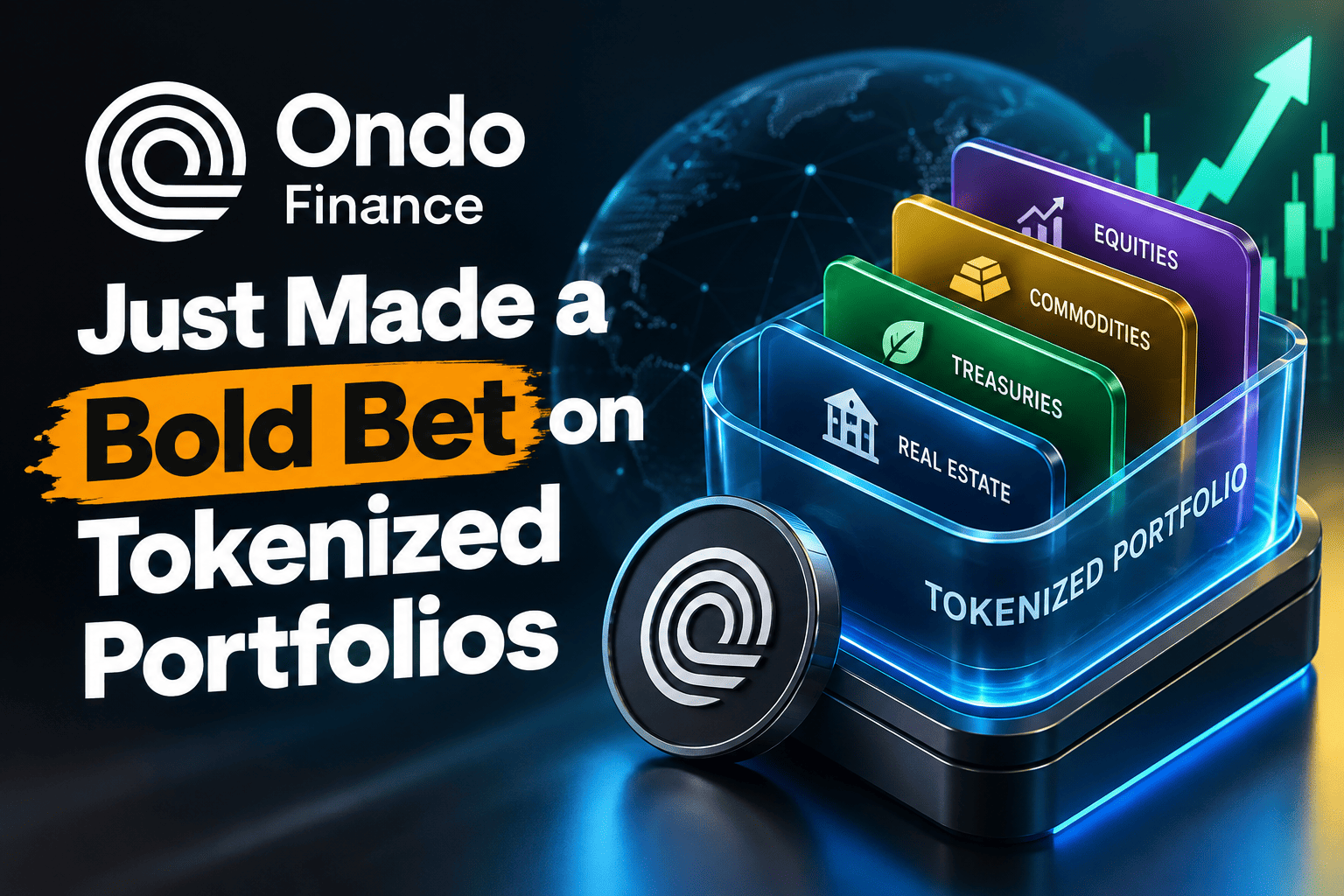
Ondo Intelligent Portfolios are not ETFs. They’re not mutual funds. They’re single onchain tokens that each represent an entire professionally designed portfolio of tokenized stocks, ETFs, and crypto assets. Instead of buying seven different stocks, rebalancing quarterly, and tracking distributions, you hold one token. Ondo does the rest.
The four new portfolios break down like this:
- MAG7Xon pairs the Magnificent Seven with crypto: 80% equal-weight Apple, Microsoft, Alphabet, Amazon, Nvidia, Meta, and Tesla, plus 15% Bitcoin and 5% Ethereum.
- BRAINon targets artificial intelligence leaders, including AI infrastructure, semiconductors, data centers, and thematic ETFs.
- YLD5on and YLD8on chase income targets of 5% and 8% respectively, blending preferred stocks, covered-call ETFs, corporate bonds, government bonds, and REITs.
These join three existing portfolios powered by BlackRock portfolio strategies: BLKHIon (high income), BLKDIGon (diversified growth), and BLKGRWon (high growth). All seven are now available to eligible non-US investors on Ethereum and BNB Chain through wallets, exchanges, and DeFi apps.
Importance of This Tokenization Partnership
Here’s the thing most people will miss: BlackRock didn’t just lend its name to this. The world’s largest asset manager developed the portfolio strategies for the original three offerings specifically for Ondo. That’s not a marketing partnership. That’s institutional infrastructure.
The numbers back up why BlackRock would bother. According to Pantera Capital’s State of Tokenization report, the tokenized asset market reached $331.8 billion as of June 2026, with non-stablecoin assets growing 13.3% in the first half of the year while stablecoins actually declined 2.3%.
The growth is coming from tokenized equities, Treasuries, and credit, exactly the categories Ondo’s portfolios touch.
Then there’s BlackRock’s BUIDL fund, which has climbed back to $2.8 billion in assets, representing roughly 18.5% of the $15.1 billion tokenized Treasury market. Ondo is explicitly named as one of the newer players contributing to that market’s growth. The relationship between these two firms isn’t incidental. It’s strategic.
The Architecture Behind the Simplicity
What makes Intelligent Portfolios technically interesting is the three-layer structure:
- Strategy layer: A model provider (BlackRock or Ondo) designs the target allocation.
- Implementation layer: Ondo’s smart contracts programmatically execute rebalancing according to preset rules.
- Access layer: You hold one token. Mint, redeem, or transfer it like any other onchain asset.
The tokens rebalance approximately every quarter back to base weights. Between rebalances, weights drift naturally with the market. When you mint or redeem, you transact directly with the issuer during US market hours, and the tokens remain transferable on secondary markets 24/7.
Here’s a critical nuance: you get economic exposure, not shareholder rights. No voting. No statutory information rights. What you do get is the total return of the underlying basket, price movement plus reinvested dividends, net of withholding taxes—flowing through to the token price automatically.
The Real Innovation Isn’t the Products
Ondo didn’t invent thematic investing. The Magnificent Seven trade is crowded. AI-focused funds are everywhere. Income strategies are as old as markets themselves.
What’s new is the delivery mechanism. These portfolios are:
- Composable: They can collateralize DeFi loans, power earn products, or even nest inside other portfolios.
- Transparent: Holdings and rebalances are visible onchain.
- Programmatic: No human emotion, no discretionary timing, no fund manager taking a cut at every turn.
Think about what this solves. Traditional ETFs offer institutional strategies and diversification, but they’re constrained by market hours, custodial layers, and geographic access. DeFi offers 24/7 access and composability, but individual investors have to assemble their own diversified positions and manage them constantly. Ondo is betting that the winning formula is hybrid: institutional portfolio construction delivered through onchain rails.
Data-Backed Research
Pantera’s report reveals something important about how tokenized assets actually behave. Tokenized Treasuries have a monthly turnover rate of just 0.1%, they’re held, not traded. Tokenized equities, by contrast, show turnover rates around 204.6%, meaning they change hands roughly twice a month.
This distinction matters for understanding Ondo’s strategy. The income portfolios (YLD5on, YLD8on) are designed for hold-and-collect behavior. The thematic portfolios (MAG7Xon, BRAINon) are designed for trading and momentum. Ondo isn’t just launching products, it’s segmenting the market by behavior.
Meanwhile, Robinhood Chain’s tokenized equity volume jumped from $5.6 million in June to $28.4 million by July, with weekly trading volume hitting $887.5 million by August.
Consumer demand for tokenized assets is accelerating. Ondo’s timing reflects awareness of that curve.
What Could Go Wrong
Let’s be direct: tokenized portfolios carry risks that traditional ETFs don’t.
- Smart contract risk is real. Programmatic rebalancing is only as reliable as the code executing it.
- Regulatory ambiguity persists. Ondo restricts access to non-US investors, but the rules could shift.
- Liquidity constraints exist. Minting and redemption follow US market hours, and some underlying assets may have thin onchain liquidity.
- Economic exposure ≠ ownership. If the issuer structure fails, token holders have no direct claim on the underlying securities.
None of these are dealbreakers. But they’re reasons why the SEC-comfortable investor should pay attention before diving in.
Conclusion
Ondo Finance just moved tokenized portfolios from novelty to infrastructure. By combining BlackRock’s institutional credibility with onchain programmability and themes that retail investors actually care about—big tech, AI, and yield—Ondo is positioning itself at the intersection of two massive trends: the tokenization of everything and the democratization of sophisticated investment strategies.
The company says this is an “early step” and that more portfolios are coming. Based on the architecture they’ve built, that’s not wishful thinking. It’s a roadmap.
Whether Ondo becomes the BlackRock of onchain portfolios or gets leapfrogged by competitors copying the playbook, one thing is clear: the wall between traditional asset management and decentralized finance is getting thinner by the quarter. The Magnificent Seven now trades as a single token. AI infrastructure exposure fits in a wallet. Income strategies settle onchain.
That’s not a product launch. That’s a preview of where investing is heading.